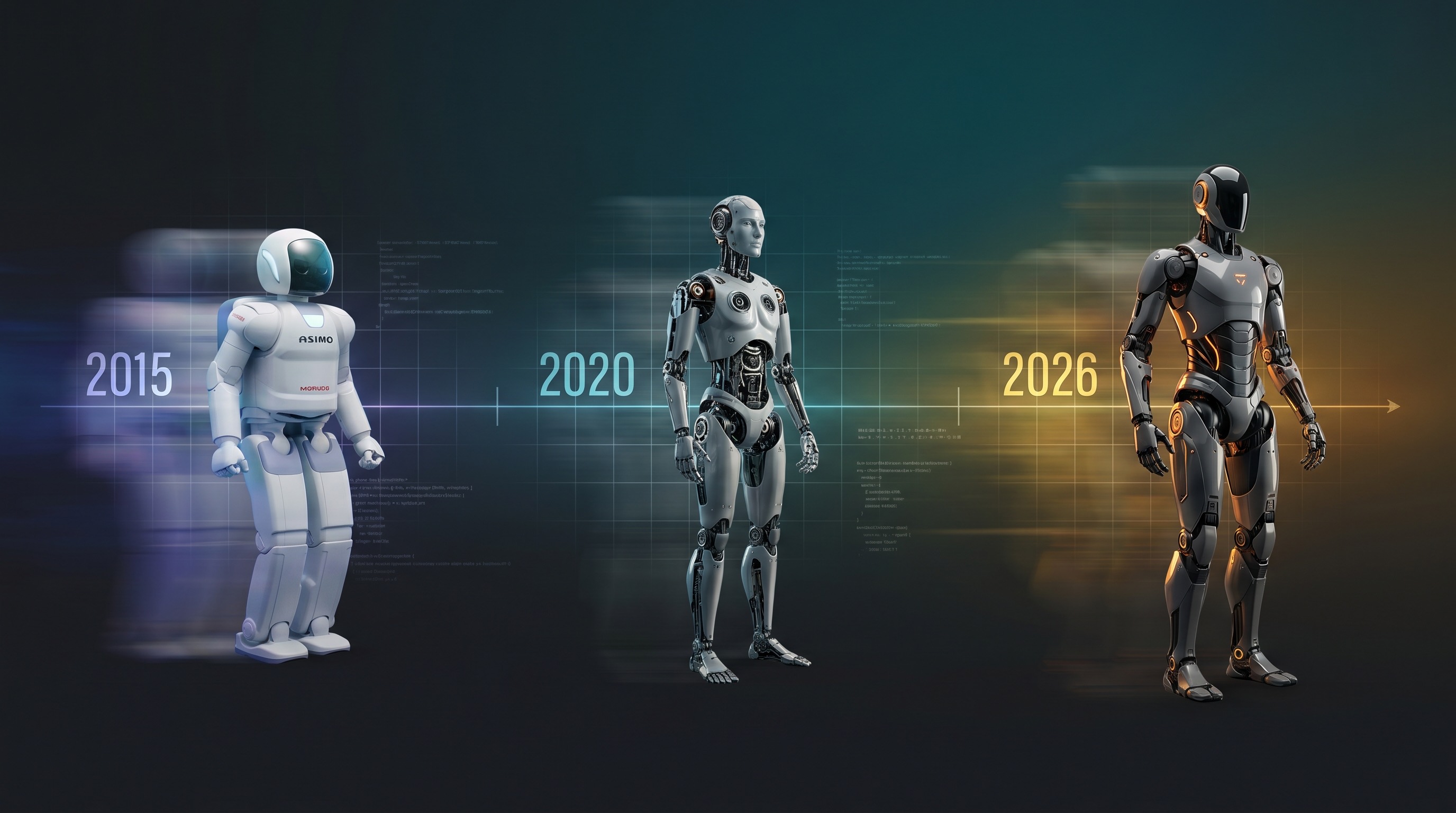
A Decade of Humanoid Robotics: From ZMP to VLA
The Paradigm Shift from Model-Based Control to Learned Policies
A decade of humanoid robotics (2015–2026): four catalysts, System 0/1/2, frontier companies, and Manufacturing Physical AI.
First published: 2026-04-24 | Last updated: 2026-06-18
16 Chapters, 5 Parts
From the old stack to VLA in one book.
Foundations + Modern Theory
LIPM/QP to PPO, Transformers, Diffusion policy, and VLA — theory bridges included.
Manufacturing Physical AI Lens
Where Korea's manufacturing strength meets global humanoid competition.
Part I: The Old Stack and Its Legacy
The Orthodox Stack (2003–2015): Glory and Limits
Kajita's LIPM, ZMP preview control, whole-body QP, and capture-point footstep planning. The ASIMO, HRP, and DRC-Atlas lineage. Why model uncertainty, contact, and latency made this paradigm brittle.
→ 02Foundations That Still Matter
Theoretical legacies from LIPM, ZMP, whole-body QP, and MPC that survived into hybrid controllers and System 0 PD loops. Foundational concepts readers need before Parts II–III.
→ 03Paradigm Shift Overview
A map of how the four catalysts depend on each other — QDD underwrites RL, GPU simulation underwrites DR, and so on. A roadmap for the rest of the book.
→Part II: The Four Catalysts
Hardware: QDD Actuators
The MIT Cheetah (2017) lineage. Outer-rotor BLDC + low-ratio planetary gears enable backdrivability, high bandwidth, and proprioceptive ground reaction force. The path to Unitree, Figure, and 1X.
→ 05GPU Massively Parallel Simulation
Isaac Gym (2021) as the inflection point and Rudin et al.'s ANYmal-in-minutes. Isaac Lab, MuJoCo MJX, Genesis, and Humanoid-Gym as the 2026 standard. The sample scale that made domain randomization practical.
→ 06The Learning Algorithm Canon
Hwangbo (2019) actuator network, Lee (2020) teacher-student, Kumar (2021) RMA, Siekmann (2021) Cassie, Radosavovic (2023) full-size transformer. The history-encoder progression: TCN → LSTM → Transformer.
→ 07Sim-to-Real: Three Strategies
Domain randomization, system ID with actuator networks, and residual corrections (ASAP-style delta action). Why reactive footsteps now emerge per control tick instead of being planned.
→Part III: The 2026 Standard Stack
Modern Theory Primer
A theory bridge for digesting Parts II–III — RL and policy gradients (PPO/TD3), transformer history encoders and in-context adaptation, diffusion policy, and the VLA concept. The 'new foundations' paired with Ch 2's classical ones.
→ 09The 3-Layer System 0/1/2 Architecture
The industry lingua franca after Figure's naming. Three layers running at different frequencies (1 kHz / 100 Hz / 7–10 Hz) and parameter scales (10M / 1B / 7B), communicating asynchronously. How this differs fundamentally from the old decoupled pipeline.
→ 10VLA and Loco-Manipulation Integration
OpenVLA, GR00T N1/N1.5, Helix, GO-1/GO-2, and π0. Treating locomotion as a solved primitive beneath a VLA. The roles of diffusion policy and latent action.
→Part IV: Frontier Company Analyses
The Incumbent: Boston Dynamics
Electric Atlas (56 DOF), the RAI Institute joint RL pipeline, and TRI's Large Behavior Model. Decades of MPC and simulation assets complementing — not replaced by — RL. The canonical hybrid MPC+RL system.
→ 12US Challengers: Figure AI and Agility Robotics (with Tesla Optimus Outlook)
Figure Helix 02's end-to-end 'pixels to whole body' with BotQ vertical integration vs. Agility's Motor Cortex and GXO deployment leadership. The chapter closes with what's publicly known about Tesla Optimus and the positions still unknown.
→ 13China's Leaders: Unitree and AgiBot
Unitree's G1 at $16K and unitree_rl_gym as the research-grade Android, versus AgiBot's GO-2, Genie Sim 3.0, and the million-trajectory AgiBot World. Two Chinese strategies: open hardware reference versus vertically integrated data-sim-deployment.
→Part V: Korea's Opportunity and Future Scenarios
Korea's Position and the K-Humanoid Alliance
The technical positions of Korea's ecosystem — Hyundai Robotics, Rainbow Robotics, NAVER LABS, KAIST, SNU and others. Diagnosing the gap with frontier groups and assessing government initiatives such as the K-Humanoid Alliance.
→ 15The Four Differentiation Axes Through the Manufacturing Physical AI Lens
Manipulation data, onboard VLA, fleet learning, and cross-embodiment — how each axis intersects Korean manufacturing strengths (semiconductors, automotive, shipbuilding, batteries). The strategic requirements for a 'Manufacturing Physical AI' thrust.
→ 16Staged Diffusion: Manufacturing Physical AI Conquest and Industrial Spread
A conquest sequence in Manufacturing Physical AI — unlocking dexterous manipulation, then autonomous fixed-line automation, then flexible manufacturing — followed by domestic industrial spread (semiconductors, automotive, shipbuilding, batteries), overseas spread, and the final transition to services and homes. Energy, regulatory, and labor bottlenecks throughout.
→